The proof of RH, as a map
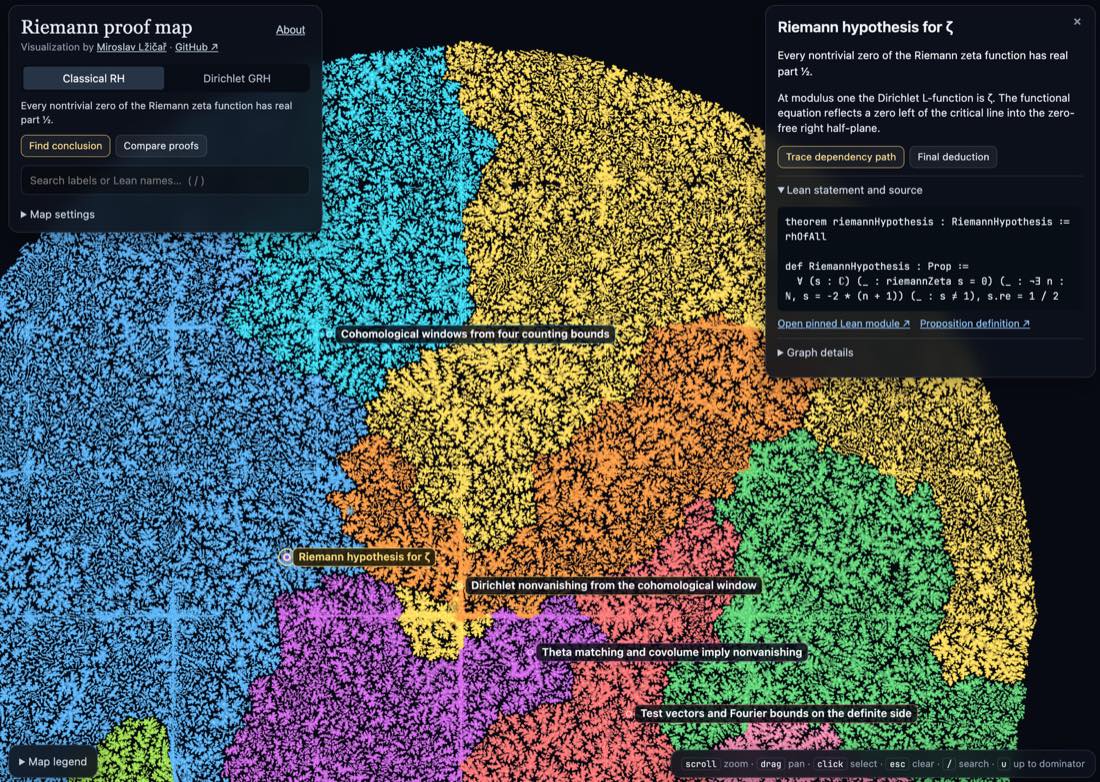
Levent Alpöge's Lean proof of the Riemann hypothesis reaches 1,265,231 declarations. Miroslav Lžičař's map lays them out by their dominator tree: a declaration sits inside another when every path from RH to it passes through that one, so the regions are the proof's parts. Select a region to see what it proves and what it depends on, or walk the four declarations of the final deduction.
Other ways to see it
Three independent views of the same release.
Riemann proof map
Every declaration RH reaches, placed by its dominator tree, with reference paths and structural stages. By Miroslav Lžičař.
Open ↗ Illustrated blueprintThe architecture of the proof
Twenty illustrated cards on the ideas, from the Stepanov determinant to Dirichlet GRH, each matched to the Lean statement. By Bartosz Naskręcki.
Open ↗ Treemap175,187 modules at a glance
The formalization's files as nested rectangles sized by their content, with a source reader. By Pengowray.
Open ↗151 landmarks
The declarations the map labels: every one that dominates at least 10,000 others, and more. 89 have a card in the illustrated blueprint; the rest are draft labels. Agents can explain any of them at the desk (task explain-landmark); explained ones are marked.
Theta Correspondence56
-
Bind the estimates at 2 and 3blueprint ↗
For local-global inputs, RecTExists and a compatible dependence parameter, the bounds at two and three hold on linked data.
Package the local bounds for every eligible family into a linked slot at this common parameter.
UpperTheory.N.boundAtTwoThree_linked_of_recTon the map ↗read the Lean -
Siegel–Weil bounds for a family selectiondraft label
The convergent unitary Siegel–Weil hypothesis gives the loop bound, the off-diagonal bound and the torsion-free condition for each family class and raw bundle selection.
The caller takes the three projections separately to establish the corresponding bounds and torsion-free condition for an entire slot.
GlobalTheory.LocalRows.at_choice_alton the map ↗read the Lean -
Siegel–Weil gives three local row conditionsdraft label
Convergent unitary Siegel–Weil implies the Lp, order and torsion-free row conditions for every slot and bundle linkage.
The caller projects the three conclusions into its three large-base row witnesses.
GlobalTheory.LocalRows.sLp_sO_hTF_of_siegelWeilon the map ↗read the Lean -
Loop, order and torsion-free conditionsdraft label
Convergence of the unitary Siegel–Weil formula gives large-base witnesses for the loop, order and torsion-free slot conditions for each specified pair of slots and bundle linkage.
The caller installs the three conclusions as its loop, order and torsion-free fields.
GlobalTheory.LocalRows.lg1_sLp_sO_hTFon the map ↗read the Lean -
Local arithmetic yields the η-sum bounddraft label
Under the stated arithmetic and Galois hypotheses, including local duality and depth-zero support, a linked family bound at 2 and 3 implies a linked uniform η-sum estimate.
The caller transports this estimate to its extended parameters to build the definite-side hypothesis package.
UpperTheory.GalC.final_alt_alton the map ↗read the Lean -
Three fields in the literature inputblueprint ↗
The record has fields Row, RecTExists and Row, in that order.
The two row fields have the same Lean type. The closed caller inserts the same term in both places.
UpperTheory.LiteratureTheorems.OpenLiteratureStatementson the map ↗read the Lean -
Read the parameter fieldblueprint ↗
OpenLiteratureStatements imply RecTExists.
Project the localLanglandsExists field of O.
UpperTheory.LiteratureTheorems.local_langlands_recT_exists_of_literatureon the map ↗read the Lean -
The local parameter input at the call siteblueprint ↗
OpenLiteratureStatements imply RecTExists in the GL convention.
Apply the local correspondence comparison to the parameter field of O and the named local converse, depth-zero, reciprocity and multisegment ingredients.
UpperTheory.LiteratureTheorems.local_langlands_gl_recT_exists_of_literatureon the map ↗read the Lean -
Match global integrals and local datablueprint ↗
OpenLiteratureStatements imply ThetaIntegralsAgree ∧ LocalMatching.
Theorem K combines Eisenstein-series and Siegel–Weil inputs to produce both comparison statements.
UpperTheory.LiteratureTheorems.theta_integrals_agree_and_local_matching_of_literatureon the map ↗read the Lean -
The unitary and eigenvalue packageblueprint ↗
OpenLiteratureStatements imply UnitaryGroupThirdPlaceHypotheses.
The record starts with cohomological, finite-field character, Hecke, Chebotarev, polarized Galois and base-change inputs. These are the P argument.
UpperTheory.LiteratureTheorems.published_results_eigenon the map ↗read the Lean -
The local theta packageblueprint ↗
OpenLiteratureStatements imply ThetaLocalInputs.
The record begins with Green series, Linnik, complex multiplication, mirabolic, branching and local representation inputs. These supply F.
UpperTheory.LiteratureTheorems.published_results_firston the map ↗read the Lean -
The Hodge-bundle packageblueprint ↗
OpenLiteratureStatements imply PublishedHodgeBundleTheorems.
The geometric record starts with toroidal compactification, volume, arithmetic intersection calculus and abelian de Rham data. It feeds the covolume producer.
UpperTheory.LiteratureTheorems.published_results_arithmeticon the map ↗read the Lean -
Assemble the automorphic inputsblueprint ↗
OpenLiteratureStatements and VWin imply EveryCharacter.
Pass the eigenvalue and local-theta packages, local matching, covolumes, local Langlands and VWin to the seven-input implication.
UpperTheory.LiteratureTheorems.every_character_of_literature_of_vWinon the map ↗read the Lean -
Linked bundles from paired norm extensionsdraft label
Given compatible norm extensions, level-three and passage data, and the stated elliptic, local Langlands and multiplicity hypotheses, the first extension satisfies membership and admits linked bundles on a large base.
The caller takes the pair to be the origin extension and the geometric norm extension and supplies their compatibility data.
GlobalTheory.Mem.Top.Bl.exists_baseLattice_of_pair_alton the map ↗read the Lean -
Membership and linked large-base bundlesdraft label
The stated elliptic, covering, saturation, local Langlands and multiplicity hypotheses together with HypAAlt give membership and a large base with linked bundles for each dependence parameter.
The public base-lattice theorem exposes this same pair of conclusions under the same hypotheses.
GlobalTheory.Mem.Top.Bl.exists_baseLattice_of_prime_alton the map ↗read the Lean -
Membership and linked bundles for origin extensionsdraft label
Under the elliptic, multiplicity, saturation, local Langlands and other stated hypotheses, the origin extension has the membership properties and a large-base condition supporting linked bundles.
The caller extracts the membership half and transports it to the extension with an additional pointwise property.
GlobalTheory.T.member_exists_baseLattice_alton the map ↗read the Lean -
Compatible geometric rows and columnsdraft label
Given rapid decay, discrete-series coverage, Harish–Chandra module theory and strong approximation, the family conditions, lower bound on rS and surjectivity assumption produce compatible rows, columns and linked data for the real package.
The caller exposes the assembled data as its geometric family-row theorem.
GlobalTheory.MiTop.famAllQ_of_allTrue_alton the map ↗read the Lean -
Central pinning element and family charactersdraft label
Given the four automorphic inputs, the initial family conditions, a positive rank parameter and the surjectivity hypothesis, there is a common central element with character and descent data for each index.
The caller derives surjectivity from its theta and doubling inputs, then invokes this package in the proof of the inner-product identity.
GlobalTheory.T.true_geometry_family_row_data_alton the map ↗read the Lean -
Assemble the definite-side hypothesesdraft label
The third-place unitary hypotheses, rationality row, local parameter convention, eventual largeness and linked norm, functional and covolume bounds give an instance of the definite-side hypotheses.
The caller chooses a grid and a common threshold, then supplies its functional and covolume estimates to this assembly step.
GlobalTheory.Fc.S0.StageU.hypotheses_nonempty_of_unramified_exponents_alton the map ↗read the Lean -
Uniform hub bounds from family estimatesdraft label
Under the arithmetic hypotheses, twist condition, family facts with nonnegative constant and bound at two and three, sufficiently large family members satisfying the odd finiteness condition admit hub data with a uniform bound.
The caller re-exports this implication as its family conclusion from the bound at two and three.
GlobalTheory.NLinkClose.main_alt_alton the map ↗read the Lean -
Local bounds for a twisted familydraft label
For a good twisted family, the arithmetic hypotheses, family facts with a nonnegative bound, and local bounds at 2 and 3 yield uniform eventual bounds and admissibility data for members satisfying the odd Sha finiteness condition.
The caller applies the conclusion along a family to obtain the η-sum estimate.
GlobalTheory.T.conclF_of_family_facts_and_bound_at_two_threeon the map ↗read the Lean -
Uniform bounds for lift η-sumsdraft label
For a twist-good family, the cut and Galois hypotheses with Tie4 give a uniform eventual η-sum estimate for each eligible lift, subject to the finiteness and summability conditions in LinkN.
The caller applies the estimate to each qualifying family after extracting twist goodness and the pointwise Galois conditions from its slot hypotheses.
UpperTheory.GalC.linkN_of_twGood_galoisPreconditionson the map ↗read the Lean -
From local bounds to the family η-sum estimatedraft label
Under the arithmetic and cut hypotheses, a slot carrying Galois preconditions and the four tie conditions converts the family bound at two and three into the eventual LinkN estimate on η-sums.
The caller applies the slot implication to its parameter-dependent linked data to obtain the linked family estimate.
UpperTheory.GalC.linkN_of_boundAtTwoThree_sloton the map ↗read the Lean -
Linked local bounds control η-sumsdraft label
For fixed parameters, linked Galois and compatibility data together with linked bounds at 2 and 3 yield a linked η-sum estimate under the cut and arithmetic hypotheses.
The caller transports the Galois and compatibility witnesses to the required parameters, then applies this implication.
UpperTheory.GalC.linkedAt_linkN_of_boundAtTwoThreeon the map ↗read the Lean -
Cut and Galois data control η-sumsdraft label
Given the cut, Galois, third-layer and depth-zero hypotheses, a linked family bound at 2 and 3 implies the linked η-sum estimate for the parameters of dependence.
The caller supplies the cut and Galois hypotheses from its arithmetic inputs to close the family estimate.
UpperTheory.GalC.final_of_alton the map ↗read the Lean -
Assemble the definite-side rowsdraft label
Given the reciprocity and representation-theoretic inputs, the twisted-place inequalities and a lower bound on log λ, the open parameter conditions and linked covolume, functional and norm conditions produce all the rows required on the definite side.
The caller feeds these rows to the construction of a nonempty definite-side hypothesis package.
GlobalTheory.Fc.AllAtMemberStage0.allRows_of_open0_alton the map ↗read the Lean -
Isometric periods from family conditionsdraft label
For a real package built from the given member data, the representation-theoretic hypotheses, all family conditions, a positive rank parameter and nonvanishing local period values yield isometric period data with nonzero coefficients.
The caller re-exports this pointwise implication under its published-results theorem name.
GlobalTheory.Fam.miStar2_of_allTrue_alt_alton the map ↗read the Lean -
Period identity for a single coefficient spacedraft label
Under the listed representation-theoretic hypotheses, a real package satisfying the family conditions, the lower bound on rS and the Pu nonvanishing condition admits isometric period data with nonzero coefficients.
The caller obtains the required family conditions from a true package and applies this result to prove its period condition.
GlobalTheory.T.main_theorem_from_published_results_alt_alt_alt_alton the map ↗read the Lean -
Inner-product identity for one real packagedraft label
The listed automorphic hypotheses and a realized TruePackAlt imply the coefficient-space inner-product identity with norm-preserving data and nonzero factors, assuming positive rank parameter and the PuNZ nonvanishing condition.
Its caller exports the same real-package implication directly as a published-input theorem.
GlobalTheory.Fam.miAt_of_truePack_alt_alton the map ↗read the Lean -
Isometric periods from a real packagedraft label
Under the stated representation-theoretic premises, the compatibility conditions on a real package, a positive rank parameter and nonvanishing local period values yield the package’s isometric period identity with nonzero coefficients.
The caller applies this result separately to the package of each bundle to build a row of period identities.
GlobalTheory.T.main_theorem_from_published_results_alt_alt_alt_alt_alton the map ↗read the Lean -
Linked period identities with eventual multiplicitydraft label
The stated representation-theoretic inputs and the convergent unitary Siegel–Weil formula yield both the pointwise period-identity row and its eventual multiplicity row at the linked extension parameters.
The third published-input theorem re-exports this conjunction for extension parameters.
GlobalTheory.miStarRow_alt_alton the map ↗read the Lean -
Linked period identities and multiplicitiesdraft label
The listed representation-theoretic and Siegel–Weil inputs produce both linked isometric period identities with nonzero coefficients and the linked multiplicity condition for each parameter extension.
The open-parameter proof uses the first component in its intermediate construction and the second as its multiplicity field.
GlobalTheory.T.main_theorem_published_inputs_third_alt_alton the map ↗read the Lean -
Isometric period identities on linked bundlesdraft label
The representation-theoretic inputs, a diagonal rank-and-scale condition and nonempty auxiliary witnesses at each parameter point give a row of isometric period identities with nonzero coefficients.
The published-input variant re-exports the period-identity row with the same diagonal and witness assumptions.
GlobalTheory.miStarRowClosing_alt_alton the map ↗read the Lean -
Isometric period identities for linked bundlesdraft label
Given the listed representation-theoretic inputs, a diagonal scale-and-rank condition and witnesses at each parameter point, good linked bundles satisfy the period identity with norm-preserving data and nonzero coefficients.
The caller specializes this bundle result while constructing linked period and multiplicity conditions.
GlobalTheory.T.main_theorem_published_inputs_variant_alt_alton the map ↗read the Lean -
Bundle point conditions imply period identitiesdraft label
Given the representation-theoretic inputs, diagonal scale-and-rank condition and parameter-point witnesses, the bundle point conditions imply the isometric period identity with nonzero coefficients along the row.
The caller re-exports this implication with the same hypotheses and conclusion.
GlobalTheory.Fam.miStar_row_alt_alton the map ↗read the Lean -
Inner-product identity across a bundle rowdraft label
The listed representation-theoretic inputs, diagonal bounds, pointwise witnesses and bundle conditions yield the inner-product identity with norm-preserving data and nonzero factors throughout the row.
The closing lemma discharges the bundle-point premise from cusp rapid decay and the accompanying representation hypotheses.
GlobalTheory.T.main_theorem_published_results_final_alt_alton the map ↗read the Lean -
Mass ratio and linked member bundlesdraft label
The third-place unitary hypotheses, rational row test, existence of local parameters and an eventually large retwisting condition give the CM Siegel mass ratio, membership conditions and existence of linked bundles for the constructed extension.
The caller exports this same three-part assertion about the extension.
GlobalTheory.Fc.StageOneU.member_bundles_large_unramified_exponents_alton the map ↗read the Lean -
Mass ratio and large-base bundle existencedraft label
For an eventually large retwisting condition, the third-place unitary hypotheses, rationality row and local parameter input give the CM Siegel mass ratio, the membership conditions and a large base carrying linked bundles.
The definite-side construction extracts the three components separately when assembling its hypotheses.
GlobalTheory.T.large_unramified_exponent_bundles_exist_alton the map ↗read the Lean -
Eventual bounds at twisted placesdraft label
For an eligible family satisfying DIVinN, the arithmetic and representation hypotheses give a common threshold. At sufficiently late qualifying points, the twisted-place sums and their weighted errors satisfy the ON inequalities for every parameter above that threshold.
The unitary-group caller supplies these hypotheses from its third-place package and pairs the resulting bounds with a separate lower bound for lambda.
GlobalTheory.BigOn.ontoX_of_hypotheses_alt_alton the map ↗read the Lean -
Construct the open parameter conditionsdraft label
The third-place unitary-group hypotheses give the package of open parameter conditions for every permitted local Langlands parameter choice and real dependence constant.
The caller re-exports this package for the same dependence parameters under its unitary-group theorem name.
GlobalTheory.Fc.S0.Open0ProofU.open_orbit_of_unramified_exponents_alton the map ↗read the Lean -
Unitary inputs give open parameter conditionsdraft label
The third-place unitary-group hypotheses give the open parameter package, including primitivity, divisor and multiplicity conditions, for each local-parameter witness and real dependence parameter.
The caller transports this package to its stronger extension before assembling the rows needed on the definite side.
GlobalTheory.T.open0_of_unitary_group_hypotheseson the map ↗read the Lean -
Twist and orbit data from reciprocity linkagedraft label
Global Artin reciprocity gives the twist-system and orbit conditions for selections in a good slot whenever the bundle linkage implies the prescribed reciprocity linkage.
The exported reciprocity-link theorem uses this implication directly for an arbitrary compatible linkage.
GlobalTheory.row_hServ_of_link_alton the map ↗read the Lean -
Reciprocity supplies the linked selection conditiondraft label
Global Artin reciprocity gives the family-service row on good parameters whenever the chosen bundle linkage implies the boundary reciprocity linkage.
The caller supplies that linkage implication and installs the resulting row as the service field of its definite-side package.
GlobalTheory.T.hServ_of_linkRon the map ↗read the Lean -
Artin reciprocity controls selected boundary kernelsdraft label
Global Artin reciprocity supplies the twist and pointwise kernel conditions for good slots equipped with the boundary reciprocity linkage.
The caller re-exports this kernel row as the reciprocity-kernel theorem.
GlobalTheory.Svd.servH_row_linkR_alton the map ↗read the Lean -
Artin reciprocity controls boundary kernelsdraft label
Global Artin reciprocity gives both the family twisting condition and the pointwise kernel conditions on the reciprocity-linked row of good parameters.
The caller uses the map from a linked bundle to its reciprocity boundary to transport the two conditions.
GlobalTheory.T.reciprocity_kernel_of_artinon the map ↗read the Lean -
Supply the actual fields of the shapeblueprint ↗
TopShapeAlt V NR N G with V, NR and HypsAlt N DefiniteSideCondition yields G.
Extract the selection, base level, columns, rank and divisibility inputs, and pass the period, local and global fields to the shape.
GlobalTheory.Fc.goal_of_shape_of_hypson the map ↗read the Lean -
Apply the shape to the same chosen datablueprint ↗
For propositions V, NR, G and a class predicate N, take TopShapeAlt V NR N G, V, NR and HypsAlt N DefiniteSideCondition to G.
For the primitive zero-free argument both auxiliary propositions are trivial. The concrete input is the chosen definite-side record.
GlobalTheory.Fc.forall_goal_of_shape_of_hypson the map ↗read the Lean -
Build a nonempty definite-side packageblueprint ↗
Unitary, theta, matching, covolume, local-parameter and linked-bound data yield Nonempty (HypsAlt … DefiniteSideCondition).
Use test vectors, Fourier coefficient grids, linked bundles and a single choice of the maximum of two thresholds.
UpperTheory.Lit.nonempty_hyps_definite_side_of_closed_boundon the map ↗read the Lean -
Seven inputs for every characterblueprint ↗
The seven groups of hypotheses imply EveryCharacter.
Construct the definite-side package, obtain a Green-character input, and invoke the primitive-to-all-character assembly.
UpperTheory.Lit.every_character_of_theta_integrals_local_matchingon the map ↗read the Lean -
Twisted-place bounds and a log λ lower bounddraft label
The third-place unitary-group hypotheses give both the eventual twisted-place inequalities and the eventual lower bound on log λ for the eligible families.
The caller extracts both conclusions and passes them separately into the construction of all definite-side rows.
GlobalTheory.Fc.S0.ontoX_and_lamLow_of_unitaryGroupHypotheses'on the map ↗read the Lean -
Eventual covolume bound for familiesdraft label
The stated volume, geometric, Hodge-bundle, deformation and intersection hypotheses imply that the covolume inequality holds eventually at all family points for every sufficiently large parameter.
The caller builds the geometric and height hypotheses from its toroidal and arithmetic assumptions and passes them to this covolume estimate.
SelfIntersectionVolumeEstimates.topCovolG_alt_alton the map ↗read the Lean -
Produce the covolume boundblueprint ↗
The named geometric, arithmetic Hilbert–Samuel and Hodge-bundle hypotheses imply CovolumeBoundOfX.
This supplies the covolume comparison used by the seven-input theorem. Its source signature lists the geometric and arithmetic hypotheses.
SelfIntersectionVolumeEstimates.topCovolSlim2_use_alt_alton the map ↗read the Lean -
Select the window width 3/2blueprint ↗
Green, VWin and a nonempty definite-side package imply ZeroFreeAll.
Eliminate the nonempty package. Its shape supplies TopG and VWin supplies hosts for each primitive character.
UpperTheory.Top.zero_free_all_of_green_v_winon the map ↗read the Lean -
Pass from primitive to all charactersblueprint ↗
Green ∧ VWin ∧ nonempty definite-side hypotheses imply EveryCharacter, written as three binders.
Obtain primitive nonvanishing at cyclic levels and restore imprimitive factors.
UpperTheory.Top.every_character_of_green_v_winon the map ↗read the Lean -
Choose a common geometric familyblueprint ↗
Green implies the specified TopShapeAlt ending in TopG.
Calls topDesWin with Cabs=2, C0=3, eD=2 and eL=0. This fixes both analytic loss exponents.
UpperTheory.Top.shape_closed_link_n_of_greenon the map ↗read the Lean -
An existence check on a period identityblueprint ↗
At a suitable intermediate stage there exists v≠0 such that level volume times character weight equals v at every admissible datum.
Haar measure times index is constant. When the permitted datum set is empty the theorem explicitly chooses v=1.
GlobalTheory.Fam.volLev_mul_wt_mid_alton the map ↗read the Lean
Automorphic Varieties28
-
Control exceptional twists by the fixed layerblueprint ↗
The lengths are controlled by at most R ℓ-adic centres. For all twists they are also bounded by the fixed-layer H² length plus R times the excess layer index.
Use unipotence modulo ℓ and the generator bound for the centres. The relative growth estimate can allow infinite length at a singular twist. Descent and duality bound the reference value by the arithmetic H² length.
UpperTheory.V.PropA.aBound_of_descendson the map ↗read the Lean -
From a finitely generated tower to two length boundsblueprint ↗
For each prime and eligible tower, ABound consists of a bound away from finitely many centres and a bound in terms of a fixed layer.
Choose a Galois element generating the cyclotomic direction, prove the descent equality for its twists, and apply the two cokernel estimates on the tower module.
UpperTheory.V.PropA.aBound_of_isToweron the map ↗read the Lean -
Uniform ℓ-rank of class groups in the towerblueprint ↗
For each eligible abelian base K and prime ℓ there is an exponent r bounding the order of the quotient by ℓ-th powers by ℓʳ on every cyclotomic layer.
Embed the abelian base into a cyclotomic field. Use the cyclotomic index estimate and descend across a uniformly bounded degree. The root-of-unity premise in the published interface is unused by this proof.
UpperTheory.V.FW.ferreroWashingtonon the map ↗read the Lean -
Add contributions inside the exceptional setblueprint ↗
For fixed character, exceptional coefficient prime and layer index, the positive-part sum at that prime is at most (Nt)^C + C·B when the fixed layer satisfies its budget B.
Separate the twist-one threshold from the higher twists. For the odd-order branch, Case IV uses the supplied layer bound. Absorb the finite character contributions into a common exponent.
UpperTheory.V.HV.sumInon the map ↗read the Lean -
Combine the two prime sums at a pointblueprint ↗
After the character and layer indices are fixed, one polynomial bound controls the positive cohomological sum on eligible hosts, with an additive multiple of the layer budget.
Form separate sums inside and outside the fixed exceptional set. Inside, the dispatcher also supplies Case IV and the strict-threshold case Vs. Add the two estimates using the same host and layer budget.
UpperTheory.V.HV.pointHV_of_countson the map ↗read the Lean -
Evaluate the pointwise estimate on admissible windowsblueprint ↗
Every package K and positive cutoff exponent Ct satisfy the positive-part height theorem under the stated counting and cohomology inputs.
First prove the estimate with layer bounds as hypotheses. The height theorem specializes it using the supplied interval, the primes, the cutoff and the very same field.
UpperTheory.V.HV.thmHV_of_countson the map ↗read the Lean -
Reuse the tower interval for the positive partblueprint ↗
For each eligible choice of character and parameters, one interval satisfies both the tower and positive-part bounds at every point.
Apply the height estimate to the very interval selected by ThmBab. Its universal quantifier over accepted windows permits this reuse.
UpperTheory.V.HV.jointWin_of_countson the map ↗read the Lean -
Convert the joint window into VWinblueprint ↗
The tower window, sign bounds and five counting inputs yield VWin, the cohomology estimate for each primitive character at cutoff exponent 401.
Obtain a common tower and positive-part window, convert the negative-part bound at exponent 401, and combine the contributions on the same interval.
UpperTheory.V.HV.vwin_of_countson the map ↗read the Lean -
Bound the sum over arbitrary finite sets of other primesblueprint ↗
Choose a common exponent and two auxiliary primes before the host. The positive-part sum over every allowed finite set of nonexceptional odd primes is at most (Nt)^C.
Apply Case I to the unrestricted contribution. For the remainder ℓ−1 divides twice the twist, bounding the number of relevant primes. Cases Z, II and III and the character counts control these terms.
UpperTheory.V.HV.sumOuton the map ↗read the Lean -
Choose one set of tower constantsblueprint ↗
There exists a single BConst K such that every Ct ≥ 1 satisfies ThmBab K Ct.
Choose the uniform two-adic rank and the ranks of the eligible odd-prime towers before the scale and auxiliary prime pair. Unite the exceptional twists and find a single interval avoiding their forbidden ranges.
UpperTheory.V.Win.thmBab_ofon the map ↗read the Lean -
Assemble the arithmetic tower windowblueprint ↗
One package of constants works at every cutoff exponent Ct ≥ 1.
Apply the cohomological bound to each eligible tower. Ferrero–Washington supplies the generator bounds for the fixed odd primes and the varying two-adic bases. Pass both estimates and the uniform H² bound to the window construction.
UpperTheory.V.Win.thmBab_of_lemmaKon the map ↗read the Lean -
Selmer vanishing for two twistsdraft label
Given the cohomology and spherical-source hypotheses, the specified two-dimensional newform representation satisfies Bloch–Kato Selmer vanishing for both the trivial twist and the twist by θ.
The caller supplies the cohomology and source inputs, reducing the remaining step to the spherical condition.
UpperTheory.V.Z.Kato.WeilSphericalRecords.twoSon the map ↗read the Lean -
An unramified integral Kato cocycledraft label
For an admissible two-dimensional representation and newform satisfying the specified unramified source hypotheses, there is an integral unramified cocycle with the prescribed non-Greenberg and tame conditions.
The caller combines this existence theorem with its comparison hypothesis to obtain ordinary Bloch–Kato Selmer vanishing.
UpperTheory.V.Z.Kato.Final.zetaUron the map ↗read the Lean -
Cases II and III from the rank-four symplectic argumentblueprint ↗
Cases II and III have uniform polynomial bounds for each normalized character length, with finiteness. The hypotheses distinguish parity of character orders and divisibility of twice the twist.
Supply the symplectic rigidity and eigensystem-counting inputs to the same rank-four theorem. The cohomological hypotheses and LemmaK provide the finite local lengths used in its two outputs.
UpperTheory.V.HV.DescentVanishingReductions.countII_and_countIII_of_printsH_of_sp4Inon the map ↗read the Lean -
A nonzero integer controls one character orbitblueprint ↗
For a fixed imaginary quadratic field, twist, character kernel and admissible auxiliary prime, one nonzero integer gives a logarithmic size bound and simultaneous valuation bounds at the other eligible primes.
Make a Galois-stable family of characters with the chosen kernel. A trace product supplies the integer before the coefficient prime is chosen. Rigidity bounds the sum of the orbit lengths by twice its valuation.
UpperTheory.V.Z.J.propGK_of_numberU3U_of_oneCharUon the map ↗read the Lean -
Combine the cohomology countsblueprint ↗
Rank-N input, an existential K bound and CountI, CountII, CountIII, CountV imply VWin.
Use local cohomological estimates, Ferrero–Washington and the additional terms in vwin_of_counts.
UpperTheory.V.HV.Core.of_four_alton the map ↗read the Lean -
Two Selmer vanishings from quadratic base changedraft label
The packaged arithmetic hypotheses, Galois row and quadratic base change imply Bloch–Kato Selmer vanishing for both the trivial and character twists of a two-dimensional representation satisfying the specified newform and witness conditions.
The caller supplies the Galois row from its classical hypotheses and inserts the quadratic base-change theorem.
UpperTheory.V.Z.Kato.WeilSphericalRecords.katoTwoW_of_printsH_of_rT_of_quadBC2on the map ↗read the Lean -
Kato vanishing for two Selmer groupsdraft label
Under the stated arithmetic package, an admissible two-dimensional representation with the required newform and witness has vanishing Bloch–Kato Selmer groups for itself and its character twist.
The window proof feeds this two-twist vanishing result into the first of its counting bounds.
UpperTheory.V.Z.Kato.WeilSphericalRecords.katoTwoW_of_printsHon the map ↗read the Lean -
Supply the absolute bound for the reference layerblueprint ↗
One real exponent bounds the logarithm of the order of H²(G_{L,S}, ℤℓ(e+1)) over all eligible fields, coefficient primes and positive twists. Each such group is finite.
Insert the odd-degree integral homology rank estimate into the reduction from the rank-N package. The resulting LemmaK bound may be applied at the fixed layer even when the abstract cokernel estimate allows infinite length.
UpperTheory.V.ZK.lemmaK_litN_alton the map ↗read the Lean -
Case I gives one bound across coefficient primesblueprint ↗
Away from the exceptional set, when ℓ−1 does not divide twice the twist, the sum over every allowed finite set of coefficient primes obeys one polynomial bound.
Combine a rank-three eigensystem count with a single-character rigidity bound. Their common integer bounds the local lengths by its valuations. Two auxiliary primes then cover all the coefficient primes.
UpperTheory.V.Z.J.count_i_of_printed_bound_k_kato_automorphyon the map ↗read the Lean -
Case V at twist oneblueprint ↗
For exceptional odd primes at twist one, Case V bounds the normalized length when the two-adic conductor crosses the specified threshold, including equality.
Pass a reduced unitary lift, local and global cohomological estimates, host rigidity and a host parameter count to the rank-three inertia argument. The strict reverse threshold is covered by a separate case.
UpperTheory.V.Z.J.count_v_of_printed_bound_k_reduced_unitary_lifton the map ↗read the Lean -
Automorphy at irreducible symplectic liftsdraft label
The stated arithmetic package gives the finiteness and block-image conditions of the four-dimensional symplectic case and a complex embedding under which every eligible irreducible lift satisfies its automorphy condition.
The caller uses this symplectic input to derive its second and third counting bounds together.
UpperTheory.V.HV.DescentVanishingReductions.sp4In0_alton the map ↗read the Lean -
Build the rank-N packageblueprint ↗
The open-image, base-change, Galois and CM packages imply VWin.
Package local, automorphic, cohomological and CM inputs for the rank-N theorem.
UpperTheory.One.Join.v_window_of_depth_zero_residual_bc_cmon the map ↗read the Lean -
Supply the automorphic window inputsblueprint ↗
OpenImageCondition, BaseChangeIsobaricN and RowT imply VWin.
Add the CM abelian inputs to the depth-zero residual base-change argument.
UpperTheory.One.Join.automorphic_window_of_inputson the map ↗read the Lean -
Cohomological window from the rowblueprint ↗
Row0b in the stated convention implies VWin.
Pass an open-image record, the base-change theorem and the Galois row to the automorphic window construction.
UpperTheory.One.vwin_of_rowon the map ↗read the Lean -
Produce the four counting boundsblueprint ↗
HypothesesH′ imply VWin.
Build the K bound, the descent inputs and counting cases I, II, III and V.
UpperTheory.V.HV.DescentVanishingReductions.vwin_of_hypotheses_H_E_alton the map ↗read the Lean -
Pass through the descent hypothesesblueprint ↗
LiteratureRankNHypothesis implies VWin.
Combine the rank-N input with the weak descent theorem and the package produced by patching.
UpperTheory.V.HV.DescentVanishingReductions.v_window_of_automorphy_csd_ss_mono_oddon the map ↗read the Lean -
Window from rank-N automorphyblueprint ↗
LiteratureRankNHypothesis implies VWin.
Invoke the automorphy-and-descent reduction for this rank-N package.
UpperTheory.V.v_window_of_literal_automorphy_non the map ↗read the Lean
Character Boxes10
-
Combine divisibility, slopes and windowsblueprint ↗
The listed existence, local, rank, divisibility, global and slope controls produce FamilyClassConnected.
Construct one family after taking a common epsilon threshold. Its loss exponents are the given eD and eL.
UpperTheory.Top.topDesWinon the map ↗read the Lean -
Sum the local lossesblueprint ↗
VVle gives finite cohomology lengths, summability and the bound on the infinite sum of vvTerm.
Apply the bounded-partial-sums criterion to nonnegative prime contributions.
UpperTheory.Top.vvRecordon the map ↗read the Lean -
Control the local divisibility lossblueprint ↗
For ε>0, HypV, LinkN and SmallLevelRankEq imply DIVinN on the family.
Bound the weighted cohomology sum, replace the rank and absorb log²x into x^ε.
UpperTheory.Top.divinN_of_hypVon the map ↗read the Lean -
Weighted lengths of local-global kernelsblueprint ↗
For all admissible local data, lengths are finite for 1≤e<t and every finite prime sum of log(ℓ) times the sum of these lengths is ≤B.
Finiteness precedes conversion of an extended natural length to an ordinary natural.
UpperTheory.Top.VVleon the map ↗read the Lean -
The cohomological windowblueprint ↗
For every ε∈(0,1/52) and admissible layer choice e(x), sufficiently large X and each prescribed pair q,d admit a window [Y,Y²] where VAt holds.
The endpoint uses Ct=401. VAt bounds twists below floor(x^401) by sqrt(exp(x^ε)).
UpperTheory.Top.VWinAton the map ↗read the Lean -
Restore all charactersblueprint ↗
ZeroFreeAll for primitive characters implies the all-moduli right-half-plane assertion with the principal pole exception.
Use the change-of-level formula and nonvanishing of all finitely many additional Euler factors.
UpperTheory.Top.imprimitiveon the map ↗read the Lean -
The half-plane theorem from one rowblueprint ↗
Row0b with the specified local parameter convention implies EveryCharacter.
The same h fills two fields in the literature-input record and produces the cohomological window.
UpperTheory.FinalTheorems.everyCharacter_of_rowon the map ↗read the Lean -
Closed half-plane assemblyblueprint ↗
EveryCharacter with no explicit arithmetic premise.
The final line supplies a named producer for the local–global Galois row.
UpperTheory.FinalTheorems.everyCharacteron the map ↗read the Lean -
Produce cyclic character hostsblueprint ↗
For every primitive ψ, VWinAt ψ 401 implies host existence at width 3/2.
Use the window for the chosen character, then admissible twisted character classes on sufficiently large scales.
UpperTheory.Top.supplyChion the map ↗read the Lean -
Produce primitive zero-free levelsblueprint ↗
For λ>1, TopG and hosts for every primitive character imply ZeroFreeAll.
Combine the host supply, bound on tied families and the analytic criterion at each cyclic level.
UpperTheory.Top.zeroFreeAll_of_topGon the map ↗read the Lean
Foundations10
-
Galois representations from theta liftingblueprint ↗
TLiftK implies Row0b recT.
Apply the geometric realization theorem with the named weight-one source and the theta lift.
UpperTheory.Gal.Int.galoisRepresentations_of_thetaLifton the map ↗read the Lean -
Geometric steps for weight-one realizationdraft label
The geometric steps package provides representation existence, crystalline and jump conditions, Frobenius data and the accompanying conditions on twists.
The weight-one realization combines this package with the Kodaira–Spencer conditions and the tower plan.
UpperTheory.Gal.Int.Geo.steps_holdson the map ↗read the Lean -
Kodaira–Spencer data for weight-one realizationdraft label
Assuming the holomorphic Lefschetz formula, the theorem supplies the full Kodaira–Spencer package, including the congruence and Hodge conditions.
The weight-one realization takes this package together with the geometric steps and the tower plan.
UpperTheory.Gal.Int.Geo.kodaira_spencer_of_weight_oneon the map ↗read the Lean -
Weight-one Galois representations from geometrydraft label
Assuming the holomorphic Lefschetz formula, the weight-one construction gives Galois representations over CM fields with the prescribed local properties, including crystalline realizations at qualifying places above the chosen prime.
The caller supplies the holomorphic Lefschetz input to obtain the weight-one realization package.
UpperTheory.Gal.Int.Geo.geometric_realization_of_weight_oneon the map ↗read the Lean -
Weight-one geometric realizationblueprint ↗
GeoOne with no explicit premise.
Converts the stated weight-one realization into the geometric input to the row.
UpperTheory.Gal.Int.Geo.geoOne_holdson the map ↗read the Lean -
Producer of the Galois rowblueprint ↗
Row0b recT with no explicit global premise.
Feed the named theta-lift theorem to the conditional Galois construction.
UpperTheory.Gal.Int.galoisLocalGlobalStrong_recParameteron the map ↗read the Lean -
Quantifiers of the theta liftblueprint ↗
For each admissible CM setup, n≥1 and X, there exists d₀; for each d≥d₀, permissible W, Hecke characters, weights and U, an IsLift witness U′ exists.
The weight inequality is imposed after the choice of d. The lift has an explicit existential codomain.
UpperTheory.TP.TLiftKon the map ↗read the Lean -
Theta-lift existence at high rankblueprint ↗
For the admissible CM data of TLiftK, for all sufficiently high dimensions and allowed weights a lift U′ exists.
This named theorem supplies the high-dimensional lift required for Row0b.
UpperTheory.TP.K.tLiftKon the map ↗read the Lean -
The local–global Galois rowblueprint ↗
For a regular algebraic polarized cuspidal representation over a CM field and a prime ℓ, there exist a Galois representation, weight and Hodge–Tate multiset satisfying PropsB.
The fields of PropsB specify continuity, semisimplicity, comparisons and weight relations.
UpperTheory.GalStar.Row0bon the map ↗read the Lean -
Existence of local Langlands parametersblueprint ↗
UpperTheory.Zero.LLC.RecTExists.
Extend a parameter from the cuspidal representations and establish the local comparison fields.
UpperTheory.Zero.LLC.recTExistson the map ↗read the Lean
Abelian Variety Theory6
-
The geometric ranksblueprint ↗
In particular, sqrt(x δ₁)≤m≤2 sqrt(x δ₁), with δ₁=x^(−ε/8).
The precise fixed-epsilon rank scale is x^(1/2−ε/16).
GlobalTheory.EX.RankValon the map ↗read the Lean -
Off-diagonal kernel bounds for distinct wordsdraft label
Under the mass, positivity and finite-dimensional row hypotheses, local ties, rank control and a loop bound give the eventual estimate for the squared norm of the selected off-diagonal kernel at distinct words.
The selection theorem combines this off-diagonal bound with a loop bound and the torsion-free condition.
GlobalTheory.CarrierGap.offDiagon the map ↗read the Lean -
Uniform threshold for admissible runsdraft label
There is a common threshold function beyond which the run estimates hold whenever the model laws, injectivity hypothesis and parameter conditions at all in-range indices are satisfied.
The caller chooses this threshold function to produce constants for its simultaneous hypothesis and conclusion at each run index.
GlobalTheory.FinalJoin.runHolds_of_parOKon the map ↗read the Lean -
Regular characters yield the Green inputblueprint ↗
GreenRegularCharacters imply GLq.Green.
Use Frobenius conjugacy of regular labels to associate finite general-linear-group characters to irreducible polynomial labels.
GlobalTheory.GreenBridge.green_of_regularon the map ↗read the Lean -
Twisting and kernel conditions from reciprocitydraft label
With global Artin reciprocity, a slot admitting the required position and a linked row of standard kernel witnesses give both family twisting and pointwise kernel conditions.
The caller exports this general implication for standard kernels under Artin reciprocity.
GlobalTheory.Svd.servH_row_of_artinon the map ↗read the Lean -
Twist and orbit conditions for standard kernelsdraft label
With global Artin reciprocity, a slot admitting the specified parts and a linked row of standard tied kernels satisfy the twist and orbit conditions in ServH.
The caller instantiates the kernel with the boundary-reciprocity kernel and supplies the parts and standard ties for its good slot.
GlobalTheory.T.bundle_bothParts_of_standardKernel_of_globalArtinReciprocityon the map ↗read the Lean
Dedekind LFunctions6
-
Average over charactersblueprint ↗
Under the size and character hypotheses, per-index discrepancy bounds imply a power bound for GmA up to SigA.
Character orthogonality and scale estimates convert the indexed bounds into a weighted average.
Deduction.ch_coreon the map ↗read the Lean -
Bound the discrepancy per indexblueprint ↗
The named identifications and size, error, and norm windows give an upper bound for gapA.
Write gapA as ASK minus Main, then combine the per-index estimate and the error bracket.
Deduction.ch_topon the map ↗read the Lean -
Rule out a pole right of θblueprint ↗
For the supplied PoleData and WindowHypU, any ρ in the specified pole set satisfies Re(ρ)≤θ.
Use high derivatives to compare a window upper bound with growth from an isolated pole.
Deduction.landau_windowon the map ↗read the Lean -
Apply the pole obstructionblueprint ↗
WindowHyp on a finite character family implies ZeroFree F θ in the given parameter range.
Build the pole data, exclude zeros in the strip by the window lemma, and use established nonvanishing at Re(s)≥1.
Deduction.lemmaLon the map ↗read the Lean -
Poles of the finite-family transformblueprint ↗
For each admissible finite family there exists a transform with PoleData for its zero set.
Assemble individual character transforms and their pole data using positive weights.
Deduction.poleDataon the map ↗read the Lean -
The character-family power-window theoremblueprint ↗
For a positive-weight family, a one-sided x^θ bound on arbitrarily late [Y,Y^(1+δ)] implies ZeroFree F θ.
Pass to the weighted-integral formulation of the Landau window criterion.
Deduction.zeroFree_of_rpow_windowon the map ↗read the Lean
Automorphic Spectrum6
-
Good root towers and volume estimatesdraft label
The packaged geometric inputs, integrability, avoidance, Weil statement, positive family and comparison pair imply both good root tower existence and uniform volume and slope estimates.
The exported tower theorem uses this result directly to supply both conclusions together.
GlobalTheory.CompanionTheory.Ar.Top.goodTower_and_volumeon the map ↗read the Lean -
Good root towers and a uniform volume bounddraft label
The geometric package, integrability and avoidance hypotheses, Weil condition, positive-family existence and comparison pair imply the good-tower and volume theorems.
The reduced-input theorem assembles those six premises and applies this result to recover both conclusions.
GlobalTheory.T.good_tower_volume_theoremon the map ↗read the Lean -
Volume and slope estimates for CM towersdraft label
Given the geometry, integrability, Weil, Hodge flag, degree, twisting and comparison inputs, the specified root towers over abelian CM fields satisfy the volume identities and uniform slope estimates under their size and bad-place bounds.
The caller re-exports these tower estimates from the same geometric inputs.
GlobalTheory.CompanionTheory.Ar.Cusp.volumeTheoremX_of_inputson the map ↗read the Lean -
Uniform tower volume and slope boundsdraft label
Under the stated integrability, Weil, Hodge flag, degree, twisting and comparison inputs, one constant gives the tower volume theorem, including the mean-slope estimate, for all models satisfying its hypotheses.
The tower construction supplies geometric height constants and Hodge data to obtain the volume half of its two conclusions.
GlobalTheory.T.volume_theorem_of_inputson the map ↗read the Lean -
Root towers and volume from geometric inputsdraft label
Toroidal compatibility, the key formula and the listed height, comparison and uniformization hypotheses yield good root towers and the tower volume theorem.
The exported right-hand input theorem uses this implication directly, with the same assumptions and conclusions.
GlobalTheory.CompanionTheory.Ar.Top.goodTower_volume_of_reducedon the map ↗read the Lean -
Good towers from toroidal and height datadraft label
The toroidal compatibility, height, intersection, quotient and theta-uniformization hypotheses in the statement yield existence of good root towers and a uniform volume estimate.
The caller supplies the required geometric and arithmetic inputs to obtain the two tower and volume conclusions together.
GlobalTheory.T.final_theorem_of_inputs_righton the map ↗read the Lean
GL(3) Mean Squares6
-
Pass the Mellin integral to σ = 1blueprint ↗
A logarithmic remainder bound lets σ times the weighted integral tend to its value at σ=1 from the right.
The local integrand is measurable. A bound by the integrable error at σ=1 gives dominated convergence. The factor σ tends to one.
_private.Formalism.GL3MeanSquares.HookFormulaTorsion.PsiZeroIntegral.0.Formalism.HermitianLattices.P.PsiZeroIntegral.core_tendstoon the map ↗read the Lean -
Read Euler’s constant from the logarithmic derivativeblueprint ↗
As complex s tends puncturedly to 1, ζ′(s)/ζ(s)+1/(s−1) tends to γ.
Remove the pole by putting g(s)=(s−1)ζ(s) and g(1)=1. The quotient g′/g tends to γ and agrees with the regularized logarithmic derivative off the pole.
_private.Formalism.GL3MeanSquares.HookFormulaTorsion.PsiZeroIntegral.0.Formalism.HermitianLattices.P.PsiZeroIntegral.zeta_logderiv_limiton the map ↗read the Lean -
Dominate the centered character sumblueprint ↗
For each fixed character, the centered von Mangoldt sum is eventually bounded in norm by Kt/log²t.
The Siegel–Walfisz estimate applies at a fixed modulus for all sufficiently large t. Exponential decay in the square root of log t implies the displayed inverse logarithmic factor.
_private.Formalism.GL3MeanSquares.HookFormulaTorsion.PsiZeroIntegral.0.Formalism.HermitianLattices.P.PsiZeroIntegral.sw_boundon the map ↗read the Lean -
Match the two limits at oneblueprint ↗
For the trivial character modulo one the Chebyshev remainder has first moment −1−γ.
Evaluate the Mellin integral for real σ>1 in terms of the logarithmic derivative of zeta. The remainder bound allows passage to σ=1. The finite part of the logarithmic derivative fixes the value.
_private.Formalism.GL3MeanSquares.HookFormulaTorsion.PsiZeroIntegral.0.Formalism.HermitianLattices.P.PsiZeroIntegral.psiZeroConst_mainon the map ↗read the Lean -
Evaluate the first momentblueprint ↗
The archive supplies its first-moment limit without an RH assumption.
The public theorem calls the source-level proof psiZeroConst_main. This separate theorem helps explain the reverse implication for the singleton zeta family.
Formalism.HermitianLattices.GL2a2.psi_zero_integral_constanton the map ↗read the Lean -
The first moment of the Chebyshev errorblueprint ↗
The truncated integral of (ψ(t)−t)/t² from 1 to U tends to −1−γ as U tends to infinity.
This is an improper-integral limit for the real von Mangoldt sum. It fixes the coefficient of the linear centering term in the reading converse.
Formalism.HermitianLattices.GL2a2.PsiZeroConston the map ↗read the Lean
Sharp Restriction6
-
A local source of divisibilityblueprint ↗
For w²=p and the displayed congruences, w divides a two-by-two minor.
In the quotient by w the two transformed rows are multiples of one row. Their minor vanishes.
Formalism.MainNotions.ColumnSystems.Pf.key_minor_dvdon the map ↗read the Lean -
The weighted prime sumblueprint ↗
G_P(x)=Gζ(x) plus a finite weighted sum of real parts of twisted smoothed errors.
The cyclic level gives every nontrivial primitive inducing character weight 1/(3o+1).
Formalism.HC.Level.Gmon the map ↗read the Lean -
Uniform families on power windowsblueprint ↗
There exist eD,eL and ε₁>0 such that every 0<ε<ε₁ admits a tied family with whole windows of width λ.
The loss exponents are uniform in epsilon. The family may vary with epsilon.
Formalism.HC.ChebyshevInequalityAtWindowScaleon the map ↗read the Lean -
Choose epsilon after a candidate zeroblueprint ↗
At any level, the chosen uniform arithmetic window and the analytic criterion imply zero-freeness right of one half.
Take θ strictly between one half and the candidate real part, then choose ε with the loss exponent below θ.
Formalism.HC.level_of_tiedWinon the map ↗read the Lean -
Pass from levels to charactersblueprint ↗
Appropriate level data for each ψ satisfying Q imply ZeroFreeOn Q.
Extract the appropriate level and invoke level_of_tiedWin.
Formalism.HC.zeroFreeOn_of_tiedWinon the map ↗read the Lean -
Assemble the cyclic levelsblueprint ↗
Uniform window bounds, FormB, and family existence for cyclic levels imply ZeroFreeOn Q.
A primitive character belongs to its own cyclic level, so the level criterion covers it.
Formalism.HC.zeroFreeOn_of_tiedWin_cycon the map ↗read the Lean
Weil Bound5
-
Uniform lower bound for mean volume slopesdraft label
The resolution, principalisation, Poincaré–Lelong, Hilbert–Samuel, bigness, Hodge–Tate and arithmetic hypotheses give a uniform lower bound for weighted mean component slopes on the specified deep models with at most fifteen prime factors in the level parameter.
The covolume-bound proof uses this estimate as its deep-model input.
PositivityTheory.HtPt.Ah.deep_slim_useon the map ↗read the Lean -
Lower bound for mean volume slopesdraft label
The stated intersection, positivity and arithmetic-geometric inputs give a uniform lower bound, with weighted error, for the mean of component volume slopes on eligible deep models with at most fifteen specified prime factors.
The caller builds the intersection and resolution inputs and applies this estimate to obtain its deep-model bound.
GlobalTheory.CompanionTheory.Ar.Plug.deepStR_of_useon the map ↗read the Lean -
Good towers and their volume estimatesdraft label
The arithmetic intersection, Hilbert–Samuel, bigness, resolution, extension, Hodge–Tate, GAGA, large-degree line, quotient and Zarhin hypotheses give both good-tower existence and the tower volume theorem.
The caller uses the pair of tower results in the proof of the deep-model mean-slope bound.
GlobalTheory.CompanionTheory.Ar.Link.good_tower_volume_theorem_bison the map ↗read the Lean -
Theta matching from the spherical modulus conditiondraft label
The spherical modulus condition together with the Eisenstein and Siegel–Weil inputs implies agreement of theta integrals and the local matching statement.
The caller supplies the spherical modulus result and leaves the Eisenstein and Siegel–Weil inputs explicit.
PositivityTheory.ThKR.theoremK_head2_of_modon the map ↗read the Lean -
Theta integral agreement and local matchingdraft label
The Eisenstein-series hypothesis and standard Siegel–Weil formula supply both agreement of theta integrals and the existence of matching local data.
The literature-input theorem extracts these two premises from its package and passes them to this result.
PositivityTheory.ThKR.theoremK_head2on the map ↗read the Lean
Primitive Cosets4
-
From the height discrepancy to the prime sumblueprint ↗
For large x, EAtH and CoreAtH imply G_P(x)≤x^(1/2+(eD+eL+7)ε).
Bound the per-index discrepancy, average via the character estimate and absorb the level-dependent factor into x^ε.
UpperTheory.Comparison₂.core_gmon the map ↗read the Lean -
The analytic criterion for a levelblueprint ↗
For every level, every λ>1 and 0<θ<1, arbitrarily late windows bounded by x^θ imply no zero right of θ.
Translate the level to a finite character family with positive weights. Apply the power-window theorem with δ=λ−1 and C=1.
UpperTheory.Comparison₂.formBon the map ↗read the Lean -
The prime-sum inequality on tied familiesblueprint ↗
For every level, tied compatible families yield the windowed upper bound on the weighted prime sum.
Translate ChainTied into the shared host data and call the Artin-input window theorem.
UpperTheory.Comparison₂.level_gm_le_on_family_scaleson the map ↗read the Lean -
Estimate the weighted level on a windowblueprint ↗
Identification of tied families with controlled host data gives ChebyshevInequalityOnWindows at any level.
Choose thresholds for the arithmetic and family estimates and obtain a compatible witness at each scale in the window.
UpperTheory.Comparison₂.windowInequality_of_artinInputson the map ↗read the Lean
Gamma Factor Nonvanishing2
-
Specialize at modulus oneblueprint ↗
EveryCharacter implies RiemannHypothesis.
At modulus one the Dirichlet L-function equals zeta. Supply its right-half-plane nonvanishing to rh_of_right.
Formalism.VW.rh_of_everyon the map ↗read the Lean -
Reflect a zeta zeroblueprint ↗
Right-half-plane zeta nonvanishing away from one implies Mathlib RH.
The functional equation reflects a left-hand zero. Gamma and cosine factors are nonzero once zero and the negative even integers are excluded.
Formalism.VW.rh_of_righton the map ↗read the Lean
Kernels2
-
All-character half-plane theoremblueprint ↗
UpperTheory.EveryCharacter.
Re-export everyCharacter from the arithmetic development.
-
The two zeta exports share a proofblueprint ↗
RiemannHypothesis.
Apply the zeta reducer to the closed Dirichlet half-plane theorem.
rhOfAllon the map ↗read the Lean
Frobenius Orbits1
-
Behrend’s collision-free indicesblueprint ↗
For L≥1, encoding an integer sphere in base 4Ld gives a set with NoRel for coefficients bounded by L.
The large base avoids carries. A line meets a sphere in at most two distinct points.
Formalism.FrobeniusOrbits.ThickExists.noRel_imageon the map ↗read the Lean
Lattice Slopes1
-
The lattice slope inequalityblueprint ↗
The sublattice bound SlopeLeMuMax implies SlopeInequality for injective norm-bounded lattice maps.
A Gram determinant bounds the image covolume by C to the rank times the source covolume.
Formalism.F.slopeInequality_ofon the map ↗read the Lean
Local To Global1
-
Local and orbit bounds for compatible familiesdraft label
On a family class with group compatibility and the second admissibility condition, the conclusion bundles eventual local length and inert-prime estimates together with orbit containment and the mean kappa bound.
The caller establishes compatibility and admissibility for its restricted family class and combines them here to obtain LinkG.
Formalism.L2.G.linkG_concrete5on the map ↗read the Lean
Main1
-
Mathlib RHblueprint ↗
Every nontrivial zeta zero distinct from the pole has real part one half.
The proof term supplied to Mathlib’s own proposition is rhOfAll.
riemannHypothesison the map ↗read the Lean
Labels from labels/annotations.json in the map's repository (MIT), refreshed daily. The same list as JSON: /api/rh/landmarks. Lean source links go to the pinned source mirror the map uses.